
Saturday used to be a dead day for foundation schedules in McAllen. Since the city began offering weekend inspections for rough-in plumbing, foundation and insulation in December 2025, a crew that finishes steel placement on Friday can have a Saturday morning inspection if the request is in by Friday afternoon. For a developer carrying a construction loan, that is a real gain, and we plan our pours around it.
Foundations are the first permanent thing we build on your site and the one scope no one can fix later without tearing something out. We build spread and continuous footings, grade beams, slabs on grade, pier caps, equipment pads and the stem walls that carry masonry or tilt panels. The work is simple to describe and unforgiving in practice, because everything above depends on elevations, anchor bolt locations and concrete strength that were right the first time.
Our goal on every job is a foundation that the inspector signs off without a second visit and that the framing or steel crew can set on without shimming. That comes from a thorough pre-pour meeting, a surveyed layout and a plan for curing that suits a hot, humid climate.
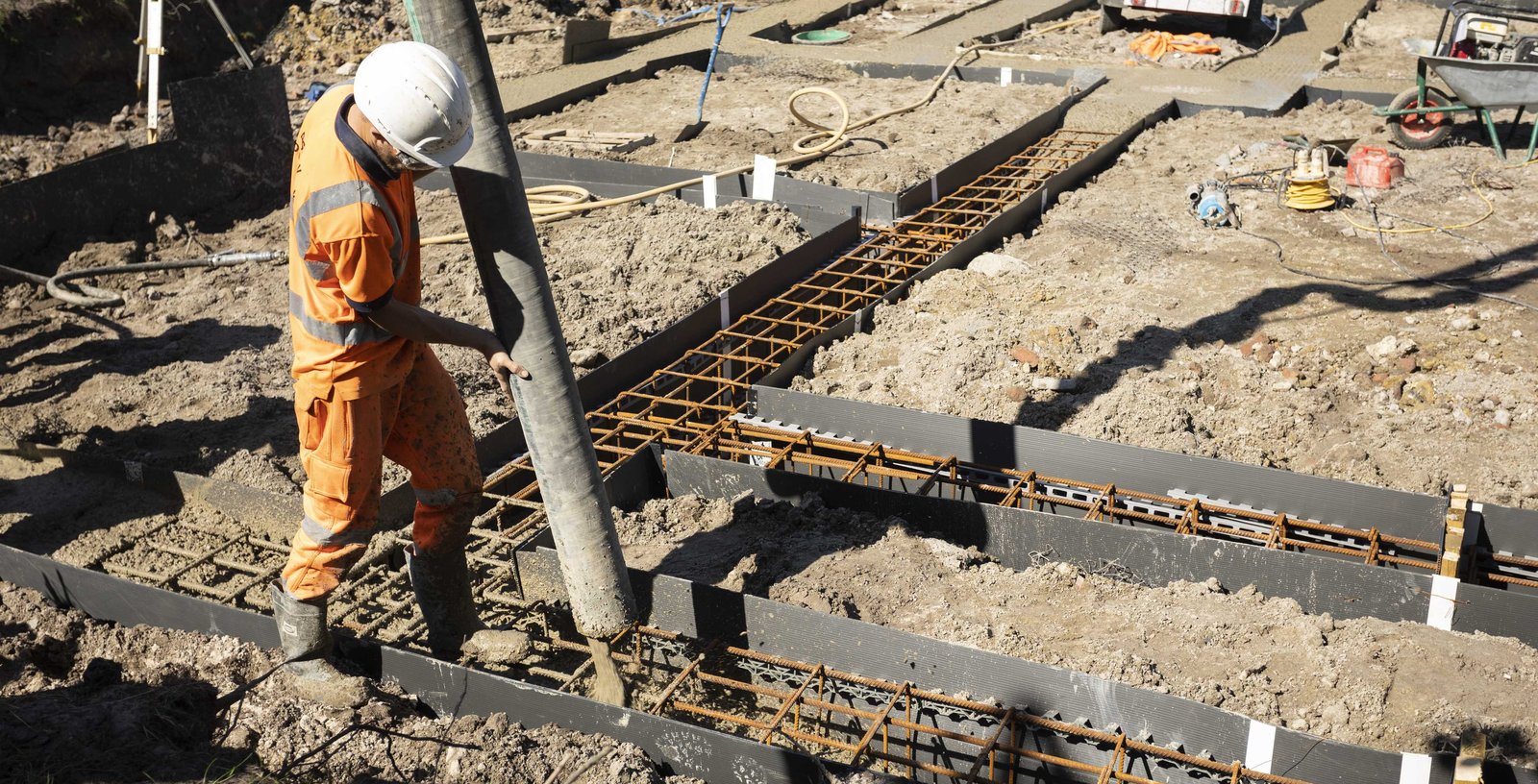
On a typical retail or office building we survey the layout from control set during grading, excavate to the engineer's bearing depth and verify the bearing material before forms or steel go in. Reinforcing is placed on chairs, tied and inspected against the structural drawings, with embeds and anchor rods templated to the shop drawings. Concrete is placed from mixes designed for the exposure, vibrated, finished and cured.
Slab-on-grade work is often bundled with the foundations because the vapor barrier, underslab plumbing, electrical conduit and slab edge all interact. We coordinate the underslab trades so nothing is buried before it is inspected. For large floor areas that need flatness tolerances, we refer you to our commercial concrete floors approach, which treats the slab as its own installation rather than an extension of the footing pour.
McAllen adopted the 2024 International Code Council codes and the 2023 National Electrical Code effective January 1, 2026, and its Building Permits and Inspections Department handles plan review, permitting and inspection. For projects in other cities, the picture is less settled. Texas law sets the 2012 International Building Code as the municipal floor, and cities adopt later editions on their own schedules, so we confirm the edition with the building department before we finalize the structural criteria.
Coastal-adjacent counties also fall under the Texas Department of Insurance windstorm program. TDI's page says that beginning April 1, 2026, Windstorm Certificates of Compliance must be certified under either the 2024 International Residential Code or the 2024 International Building Code. Whether a given parcel needs that certificate depends on the county and the zone, so we raise it at the start of any job where it could apply instead of discovering it at closeout. Foundation connections for uplift, hold-downs and embedded steel are often where wind design shows up first.
The Hidalgo soil series, mapped near Donna and used as a reference for much of Hidalgo County, is described by the USDA as well drained and moderately permeable with calcium carbonate accumulations that range from soft masses to weakly cemented concretions. That tells us two things: water will not usually stand under a footing for long, and excavation in the lower horizons may take more effort than topsoil work. It does not tell us the bearing capacity or the movement potential of your lot. Only borings do.
Large industrial sites bring other considerations. A 75,000 square foot climate-controlled warehouse reported under construction in the McAllen area, for instance, would call for a thick slab with careful joint planning and attention to vapor control, while a medical office needs tight tolerances and vibration limits for imaging rooms. Pad preparation from mass grading and underground storm lines from drainage construction both have to be settled before any form goes up.
Open trenches and deep footing excavations are where most foundation injuries happen. We slope, bench or shore every excavation deeper than the regulatory limit, keep spoil piles back from the edge, and put ladders within reach. Rebar caps, guarded edges and a clean access path for concrete trucks are routine on our sites.
Pump trucks and ready-mix deliveries also create traffic risks on occupied properties. When we pour next to an open store or a hospital entrance, we set up a flagging plan, separate pedestrians from truck paths and schedule deliveries outside peak hours when we can. Every pour starts with a short meeting covering the sequence, the crew's roles and the plan if a truck is delayed or the weather turns.
A foundation schedule is a chain of inspections. Excavation inspection, reinforcing inspection, underslab plumbing and electrical, and pour day each have to line up with the building department's availability and the concrete supplier's plant. We book the supplier early for large pours, confirm the mix design weeks in advance and carry weather contingency in July and August, when afternoon storms can interrupt a pour in progress.
Curing is a schedule item too. Concrete placed in Valley heat loses moisture quickly, so we use curing compound or wet cure on exposed surfaces and watch evaporation rates on windy days. For owners with a lease commencement date, we show the dates when steel or tilt panels can begin and what has to happen first. Related work such as drilled pier foundations is sequenced ahead of the footings that tie into them.
We pour foundations for retail centers, medical offices, warehouses and multifamily and mixed-use buildings, and each carries its own details. Retail calls for light, repetitive footings and long runs of slab. Warehouses need heavy dock-side slabs and clean edges for tilt panels. Medical work often requires deep utility penetrations and tighter tolerances. Owners comparing sites by industry can see how we work with healthcare systems and others who need predictable foundations.
Send the structural drawings and the geotechnical report. We will return a sequence with the inspections mapped out and a range that names the items most likely to change the number.
McAllen's Building Permits and Inspections Department began Saturday inspections in December 2025 for rough-in plumbing, foundation and insulation, between 8:30 a.m. and 4:30 p.m. Requests are due the Friday before, between noon and 4 p.m. We build that cutoff into the pour plan, though the city can change the program, so we confirm before relying on it.
The geotechnical report decides. If the soils at foundation depth cannot carry the loads or the movement potential is high, the engineer will call for piers or an engineered fill pad. We ask for the report early because a change after bidding is costly.
It depends on the city. McAllen adopted the 2024 codes in January 2026, while many other Valley cities have not published an edition we could confirm. We call the building department to verify before design criteria are locked.
For a mid-sized retail building, the foundation sequence is usually measured in weeks, not days, once inspections and curing are included. Larger slabs are poured in sections. We give a specific sequence once we see the drawings and the structural phasing.
They can. We watch the forecast closely and keep a rain plan with plastic sheeting and extra labor. If a storm interrupts a pour, we stop at a planned joint rather than rushing.