
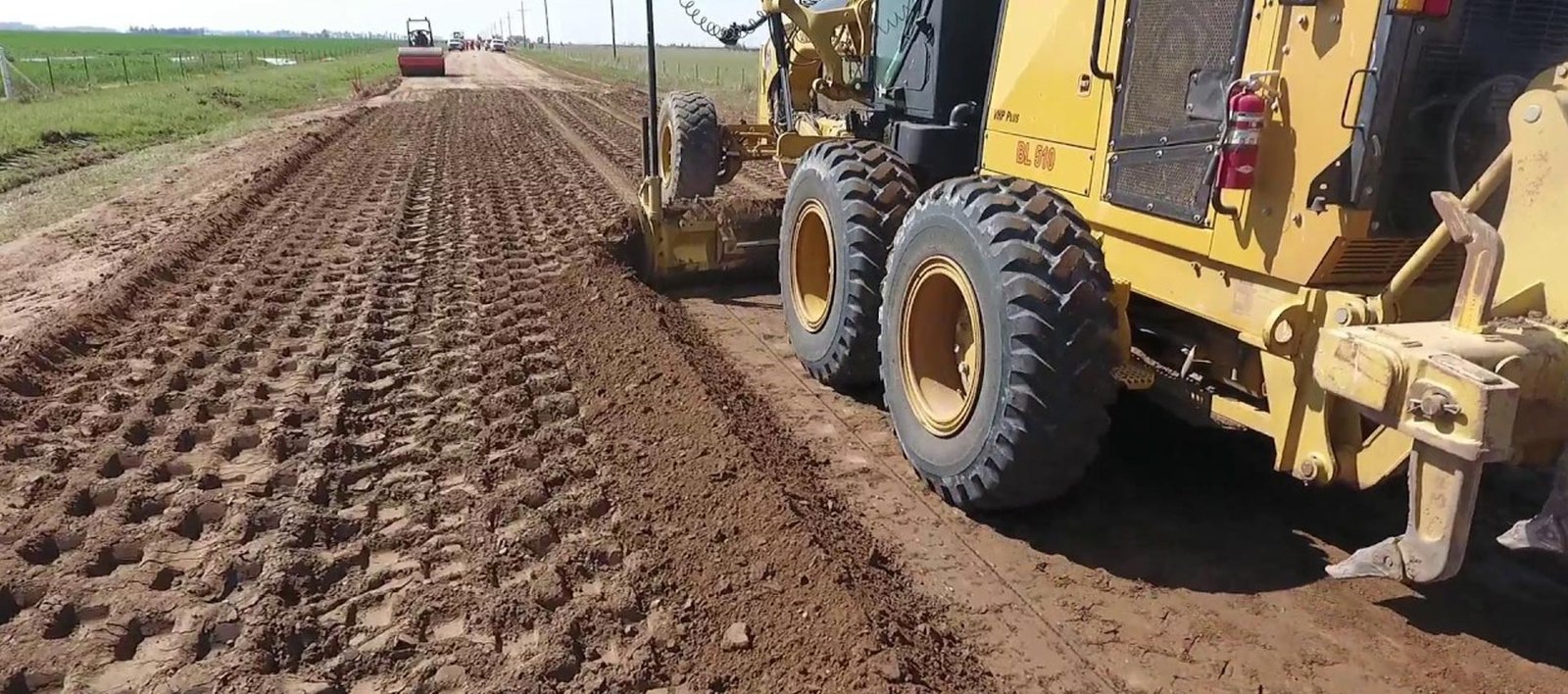
Flat ground fools people. Most of the acreage around McAllen was farm and citrus land, and a parcel that looks level from the road still has to shed rain, carry a slab and stay out of the neighbor's yard once it is paved. Mass grading is the step where all of that gets decided. We strip the surface, cut and fill to finished elevations, compact in tested lifts and hand the foundation crew a pad that has already been proven rather than assumed.
The owners who call us for this work are usually weighing a land purchase or a lease against a schedule. A retail pad, a medical office lot and a distribution building each want something different from the same dirt. Retail wants a clean, high pad and a parking field that drains toward a detention point. A warehouse wants a big, even, well-compacted plate that will not telegraph settlement through a long slab. We price both with the same discipline, and we tell you early which two or three items on your site will move the number.
If your site sits near the Ware Road industrial area or out along the western edge of the trade area, the grading package is also the first real test of your civil drawings. Questions about haul distance, fill sources and detention sizing that are cheap to answer on paper get expensive once equipment is on site.
The USDA description of the Hidalgo soil series, named for the county and mapped near Donna, calls it a well drained, moderately permeable, moderately alkaline loam, with lime showing up as films, threads or soft masses between roughly 12 and 28 inches and weakly cemented calcium carbonate concretions deeper in the profile. In plain terms, the top of the profile is forgiving, and the layer below it can be harder to cut and may behave differently as fill. Which soils your particular lot has is a matter for borings, not for a county map, but the series description tells us what questions to put to the geotechnical engineer before we commit a cut and fill balance.
Scale matters here too. Reports on the McAllen Nearshoring Campus describe a park of about 473,400 square meters with lots up to 121,000 square meters, and a separate 337,000 square foot facility there that broke ground in March 2026. Sites of that size make earthwork the largest early line on the budget. Smaller pads face the opposite problem: not enough room to balance cut and fill on site, so import and export trucking decides the price. Our site development and utilities work picks up where the grading leaves off.
The sequence is the same on a one-acre pad and a hundred-acre park, only the equipment changes. We start with erosion controls and a construction entrance, because rain does not wait for an unfinished job and a muddy tire track on a public road creates a problem that has nothing to do with the schedule. Next comes stripping, with the topsoil stockpiled where it can be reused for landscape areas instead of hauled away and bought back.
Cut and fill follow the grading plan, placed in lifts of controlled thickness and compacted to the density the geotechnical report calls for. We have the exposed subgrade proof-rolled with loaded equipment and let the soft spots show themselves before the testing lab ever arrives. Anything that pumps or ruts gets undercut and replaced. We keep the lab results organized by lift and station so the foundation contractor, the building official and your lender can all see what was placed where. For a building pad that will be followed by concrete foundations, that record is what keeps the next trade from reopening the question.
The cheapest yard of fill is the one you did not have to buy or haul. Before we mobilize, we run a quantity check of our own against the engineer's, looking for a finished-floor elevation that brings cut and fill closer together without upsetting drainage or accessibility. Raising a pad six inches can erase an import line item, and lowering a detention pond a foot can do the same. These are conversations to have with your civil engineer in preconstruction, which is why we like to be at the table through preconstruction estimating and not after the drawings are final.
Three items do most of the damage to a grading budget in this market. The first is fill source and haul distance, because import material priced at the pit looks cheap until it is trucked to the site and compacted. The second is moisture. Rainfall in the Valley arrives in a few large events, and a subgrade that was ready on Monday can need days of drying after a storm, so we carry weather time in the schedule and in our unit rates. The third is the unknown below the surface, such as abandoned irrigation lines, old foundations and buried debris on farmland that changed hands several times.
We show owners a price range early, with allowances for the items that cannot be known until the ground is open. If you are comparing sites, ask your land broker for a copy of any prior geotechnical work and let us look at it before you close. A thirty minute review of an old report has saved owners from paying full price for a parcel that needed a feature the pro forma never accounted for. When the drainage design is part of the question, stormwater and drainage work deserves the same early look.
Grading is one of the few scopes where a good schedule is mostly settled before the first scraper arrives. Clearing and stormwater permits, any floodplain development permit, utility locates and the surveyor's control all have to be in hand, because a site that starts with a stop-work notice has already lost its float.
Once equipment is turning, we aim to give the foundation trade a pad in sections rather than a single hand-off at the end. Releasing the footprint of the first building area while the pond and the parking field are still being shaped can pull weeks out of a vertical schedule. We confirm every release with test results in writing, so there is no argument later about whether the pad was ready. Industrial owners focused on dock aprons and drive aisles should read about truck courts and dock aprons before the grading plan is locked, since the subgrade under heavy pavement is graded differently from the subgrade under a lawn.
We take grading work across the central Valley, from infill lots in McAllen to raw acreage west toward Mission and south toward the river. The Sharyland Business Park in Mission, a 175 acre development reported to hold about 2.5 million square feet of planned industrial property on 15 lots of 4 to 25 acres, is the kind of subdivided site where one grading contractor coordinating lot-by-lot pads saves the developer a great deal of rework. Industrial owners and lenders who need logistics sites turned quickly can also look at how we serve logistics and distribution clients.
Tell us where the site is, what you plan to build and when you want to start. We will return a sequence and a price range, and flag the items that will move it.
It helps a great deal, and we will tell you if the price we give is only a placeholder without it. A report tells us the depth of unsuitable material, the recommended compaction and the moisture range, all of which change unit costs. If you do not have one, we can price a range and carry an allowance, then firm it up once borings are done.
We plan for it. Erosion controls go in first, the pad is crowned and sealed at the end of each day when rain is forecast, and our schedule carries weather days. A heavy storm usually means a few days of drying before compaction tests can pass again, so we do not promise dates that assume dry weather.
Often partly, sometimes fully. We compare the engineer's quantities with our own and test whether a small change to finished elevations shifts the balance. Where the site is too small or the cut is not suitable as structural fill, import is unavoidable and we price the haul distance honestly.
We coordinate them with your civil engineer. The engineer prepares the plan, and we implement it and keep the inspection records. In the unincorporated parts of Hidalgo County, a floodplain development permit may also apply, so we confirm that before mobilizing.
The lab tests density and moisture on each lift and on the final subgrade, and reports to us and to you. Failing tests mean we rework the area and retest before moving on. We keep the lab reports with the project record for the foundation contractor and the building official.