
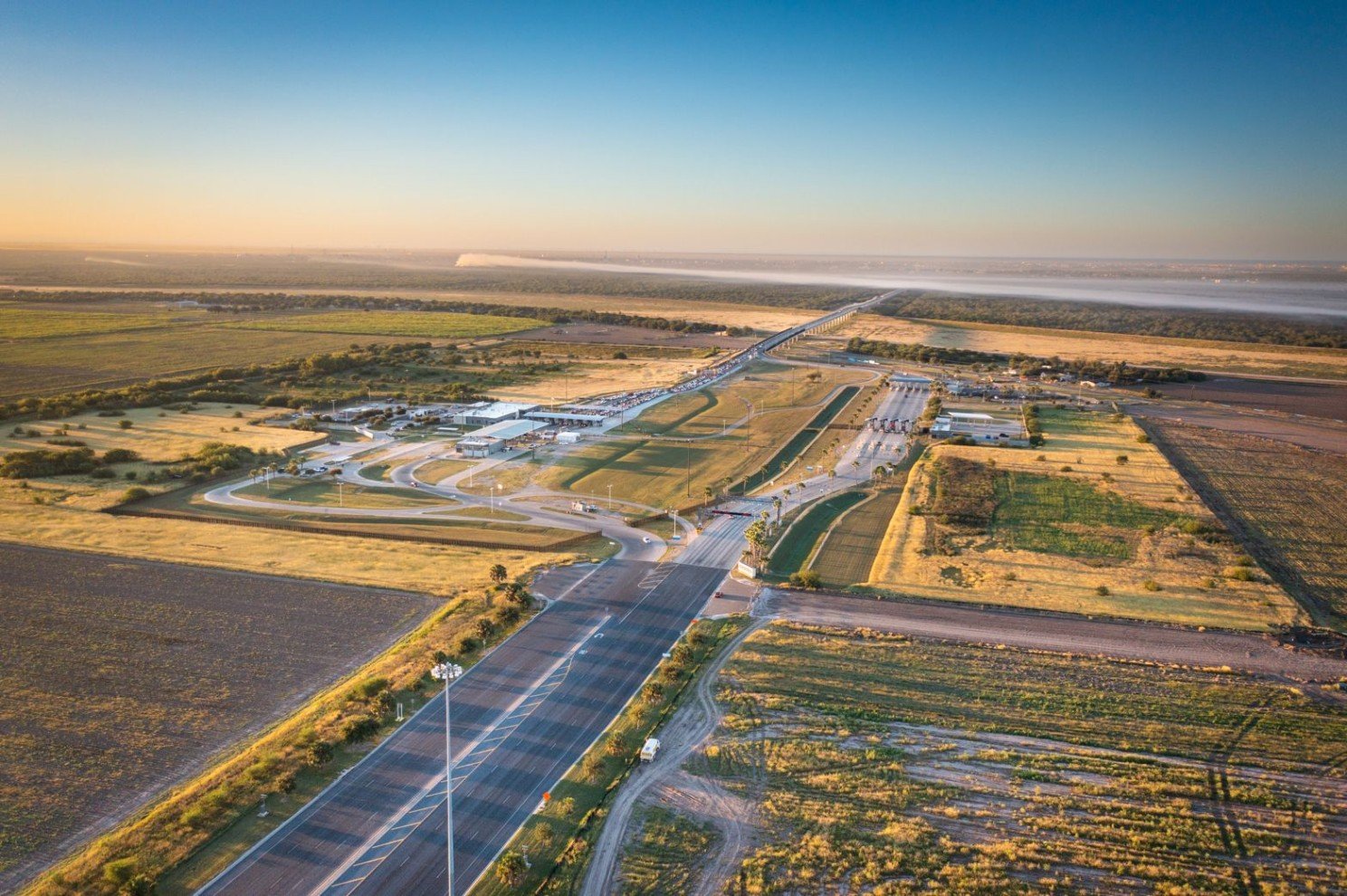
Cross-border freight depends on buildings that can turn a truck quickly, and the land near the Anzalduas International Bridge is where that kind of building is being planned and built. We build distribution warehouses, cross-docks, truck terminals and light manufacturing for owners who want to be a short haul from the crossing, with site packages that handle truck circulation, drainage and utilities before the building goes vertical. Our first conversation with a bridge-area owner is almost always about trucks: how many, how long they stay and where they line up.
The bridge itself is changing. The McAllen Chamber reported in October 2022 that an $83 million expansion of the Anzalduas crossing broke ground to build commercial inspection facilities (inspection booths, docks, roadway and parking) so the port could serve commercial trucks, funded by a $25 million INFRA grant, a $22 million TxDOT grant and a $63 million North American Development Bank loan to the City of McAllen. FreightWaves reported in December 2024 that the expansion adds one northbound and one southbound commercial lane and is estimated to handle 1,200 to 2,000 trucks a day once complete.
Those numbers describe a crossing that will generate demand for nearby staging, warehousing and inspection-adjacent space. They do not guarantee any tenant, and we advise owners to build to confirmed leases or a clearly defined user. What we can do is make the site ready for whoever signs.
FreightWaves also quoted the Mission Economic Development Corporation's executive director saying that Mission had issued about $650 million in construction permits over four years, much of it tied to cross-border trade companies, and that three projects near the bridge could add hundreds of thousands of square feet of distribution, warehousing and manufacturing space. The city processed 42,749 empty southbound trucks in 2023, a figure that shows trucks already pass through this port in numbers.
A trade publication reported on April 11, 2024 that construction started on the Industrial Park at Anzaldua's in Mission, planned at 6.3 million square feet, with about 2.2 million square feet of warehouses in a first phase and an initial $50 million, between Military Highway and Bryan Road a few miles from the bridge. A park on that scale will need roads, utilities and detention before any single building is finished, and we price the park-wide infrastructure as its own package so building users know what they inherit.
Cross-dock terminals need doors on both sides of a long, narrow building, with a truck court deep enough that a trailer can turn without blocking the next door. Our truck terminal and cross-dock work starts with the door count and the apron geometry, since the building shape follows from them. Concrete aprons, dolly pads and lighting get as much attention as the roof.
Distribution and light manufacturing users are the second group. A distribution center needs clear height, dock ratios and trailer storage, while a light assembly user cares about power, compressed air and ventilation. Both want roof systems and wall panels that stand up to Valley hail and wind, and both want a clear plan for expansion.
On a bridge-area site, we begin with the truck movement diagram. We ask where trucks enter, how they queue, which doors they serve and where drivers park or wait. Only then do we lay out the building footprint. This approach avoids the common problem of a handsome building on a site where the trucks cannot circulate, and it is easiest to fix on paper.
Site development drives schedule. The site development and utilities package includes extending water, sewer and power, building the detention basin, and installing the main drive aisles. Starting it while the building permit is still in review is a common way to shave weeks, provided the grading permit and floodplain status are clear. We also use design and build delivery where an owner wants a single price early and a fast start.
Authority depends on where the parcel sits. A site inside a city is reviewed by that city's permit office, while a site in unincorporated land falls under Hidalgo County's floodplain management order, which requires a Development Permit with a $50 fee covering administrative reviews and field inspections. The posted copy of the order leaves its adoption date blank and adopts a flood insurance study dated June 6, 2000, so we confirm the current version and freeboard requirement with the county before design.
The adopted building code also varies by city. McAllen adopted the 2024 International Code Council codes effective January 1, 2026, but the edition in force in other nearby cities has to be confirmed with each building department. We do that during preconstruction and list the result on the permit matrix, so a design team never works from the wrong edition.
For a cross-dock or warehouse, the largest swing is pavement and civil work. A truck court that handles hundreds of trucks a day needs thicker concrete or heavy-duty pavement, strong subgrade and good drainage. We price court area separately from the building and show the cost of different pavement sections, so owners can choose with full information through truck court and dock apron options.
The next driver is timing relative to the crossing. If the commercial lanes are not yet operating at their expected volume, a speculative building may sit empty longer than planned. We help owners phase the work, building the infrastructure and a first building while holding the remaining pads, which controls carrying cost without giving up the site. The City of McAllen's FY 24-25 budget book states the goal that the Anzalduas Bridge Land Port of Entry will be expanded to facilitate commercial traffic, which is a goal, not a schedule.
Bridge-area owners frequently weigh Mission sites against the Ware Road industrial area and the border-trade site in Hidalgo. Logistics buyers can read about logistics and distribution projects, and warehouse users may find the Ware Road page a useful comparison.
Send us the parcel, the truck count you expect and your target opening date. We will return a truck circulation sketch, a site package budget and a building price range.
Not necessarily, but build to a confirmed user where you can. The expansion was reported at 1,200 to 2,000 trucks a day once complete, and completion dates have slipped before. Phasing lets you build infrastructure now and add buildings as leases are signed.
A cross-dock moves freight from inbound to outbound trailers with little storage, so it is long and narrow with doors on both sides. A warehouse stores goods and needs more height and racking. The site layout, floor and truck court are different.
The Hidalgo County floodplain management order applies to unincorporated land and requires a Development Permit. Utilities and the road authority also review. We confirm jurisdiction before we design.
Big enough that trailers can maneuver without blocking doors or the public road. Trailer type, door count and the turning radius of your fleet decide the depth. We draw turning paths before we fix the building footprint.
A park developer typically builds the main roads and utilities, but each building still needs service connections, detention or tie-in, and permits. We verify what the park provides and what the building owner must build.