
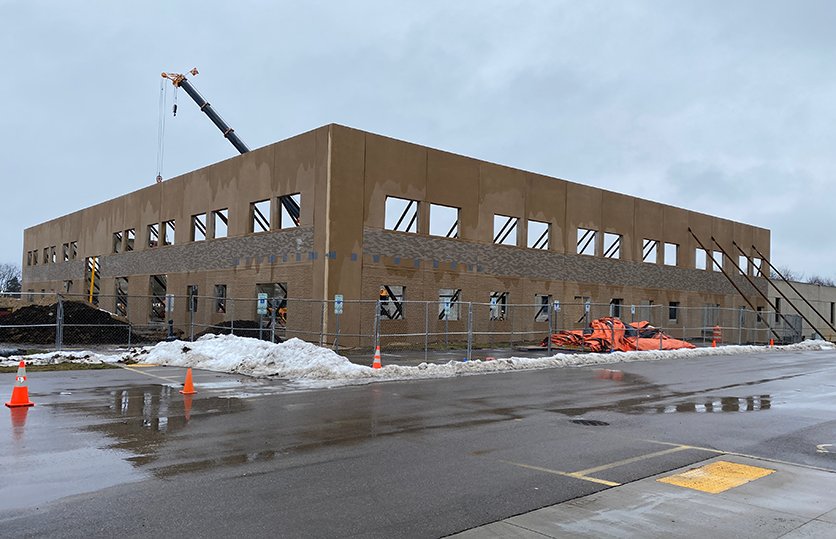
Classrooms must be ready when the first bell rings, and the bell does not move for a late delivery. School construction in western Hidalgo County is built around an academic calendar: a summer window for big work, a few weeks of winter break for smaller pieces, and strict rules about when strangers can be on a campus. We plan education projects from the first day of school backward.
We build classroom additions, new campuses, gymnasiums and fine-arts spaces, career and agricultural education buildings, cafeterias, and renovation programs for older facilities. The owners are school districts, charter operators, colleges and the professional teams that serve them, and many of them manage funding in stages, such as a bond program or a state grant, which affects how we package the work.
A school is also a building full of children, so safety comes before schedule. Our sites are fenced, supervised and separated from occupied areas, and every worker is screened as the district requires.
State project records show the range. A charter school addition on East Expressway 83 in La Joya is listed at about 27,439 square feet with a registered cost of $8,500,000, and construction scheduled from June 2024 to July 2025. Farther south, a record for an agricultural education building at 410 E. Produce Road in Hidalgo shows 3,528 square feet at $1,487,228 with construction planned from April 2026 to April 2027.
Notice the contrast. One project is a substantial addition tied to a summer window, and the other is a small specialty building with a long schedule and a high cost per square foot because of the equipment and the site. Both are typical, and our estimating approach is different for each. For the large addition, we focus on the summer window, and for the small building, we focus on the shop and lab systems.
An education scope includes site work, foundations, structure, envelope, mechanical, electrical, plumbing, fire alarm, security, data and the finishes that withstand daily use. Classrooms are modular and repetitive, which helps cost, but the special rooms drive the details: science labs with casework and gas, kitchens with hoods and walk-ins, music rooms with sound control, gyms with long-span roofs and shops with heavy electrical service.
Technology is a large piece of the work. Cabling, wireless coverage, access control and cameras are required in most new schools, and we coordinate those with the district's IT staff before the walls close. For districts that plan several buildings, we can standardize details across campuses to speed up approval and lower cost. Public owners with similar requirements should also read our municipal and government construction page.
On an operating campus, safety planning is a written document and a daily routine. We separate the construction zone from the school with fencing and signage, assign a dedicated entrance and haul route, and keep deliveries away from pickup and drop-off times. Noisy and dusty work is shifted to hours when students are not present, and we coordinate with the principal about exam days and special events.
Background checks and badges for workers follow the district's policy, and we brief every trade before they enter. Our superintendent walks the site at the start and end of each day, and any issue that touches the school, from an open trench to a blocked exit, is reported to the campus contact right away. Open excavations are covered or fenced, and no one stores materials in a path students might use.
Many school projects are won or lost in the summer. If a classroom wing has to be done by August, then foundations must be complete before the school year ends, and the long-lead items must have been ordered months earlier. We schedule submittals, approvals and orders in reverse from the occupancy date, and we show the district the dates by which decisions are needed.
A phased occupied-site approach helps when the work cannot all fit in summer. We divide the project into zones and release each one when it is complete and inspected. When a district wants the contractor involved early in design and budget, construction management at risk lets us lock the schedule and the pricing before the drawings are final.
The permitting path depends on the owner and the location. Districts and charter operators may have their own review procedures, and local building departments often still inspect. Inside McAllen, the city adopted the 2024 International Code Council codes with the 2023 National Electrical Code effective January 1, 2026. In other communities, the adopted edition can differ, and we confirm it with the local building department.
Accessibility is reviewed by the state. The Texas Department of Licensing and Regulation states that projects costing $50,000 or more must be submitted for registration and review, and both projects described above appear in its records. We prepare the submittal with the design team and schedule the final inspection before the opening date, so the building can open without a hold.
Education work shares a lot with other public buildings. Fire stations, libraries and community centers use similar structural systems, and the same public procurement rules apply. For districts and colleges that also build athletic facilities, we apply the same long-span framing and site approach to gyms and fieldhouses.
If you are comparing buildings, our education and school building type page lays out the typical program, and education institutions can see how we handle bond-program packages. Owners who want a public-sector partner for several projects in a program should ask about our approach to sequencing, because the order in which buildings are built often matters more than the size of each.
Tell us the campus, the funding and the date you need students in the rooms. We will return a phased schedule and a range, with the long-lead items identified.
It depends on size, but many additions can be done in a summer if the foundations are ready when school lets out and the long-lead items are ordered in advance. We confirm feasibility during preconstruction and show the district which dates are critical.
We fence the site, set separate entrances, screen workers, schedule noisy work outside class hours and keep a superintendent present at the start and end of each day. We also meet with the principal to coordinate around events.
Yes. Bond programs involve several buildings on a public schedule, and we organize them in packages that match the funding. Public bidding and procurement rules apply, and we follow the district's process.
Special rooms such as labs, kitchens and gyms, the site and drainage package, and technology infrastructure. Classrooms are repeatable and relatively predictable, while specialty spaces carry more cost per square foot.