
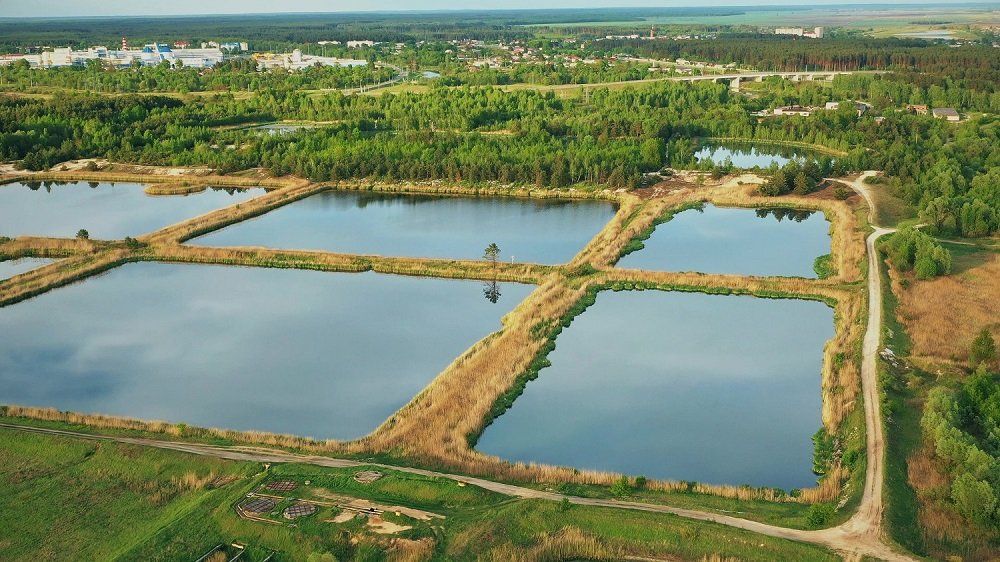
Twelve inches of rain in a couple of days is not a design storm anyone plans a parking lot around, but it is what the National Weather Service recorded at a gage northeast of McAllen when Hurricane Hanna came through in July 2020. The same event left roughly 18 inches to 4 feet of standing water across parts of Mission and La Joya. Drainage in this trade area is not a line on a checklist. It decides whether a tenant opens on time, whether an insurer is comfortable and whether the lot floods the next time a tropical system stalls overhead.
We build the drainage side of commercial work: inlets, storm sewer, culverts, swales, detention and retention ponds, outfall structures and the grading that sends water to them. Some of it is owner-driven, a pond that has to be dug before a pad can be released. Some of it is dictated by the city or the drainage district that receives the flow. Either way, we treat the storm system as the part of the site that has to work on its worst day, not the one that has to look good at closeout.
Drainage in Hidalgo County runs through a master system managed by Hidalgo County Drainage District No. 1. After Hanna, its general manager told KRGV that the network was originally agricultural and not designed for an event like that one, that water normally clears in about 48 hours, and that Hanna's rain could take several days. The district's own site points to the 2018 and 2023 drainage bond programs and a stormwater management program, along with a proposed $14.5 million South Lateral Drain Phase VII flood mitigation project.
What that means for a developer is simple. A private detention pond is not a formality here. If the receiving system is slow to drain, your outfall may sit backed up for days, and the pond has to hold more than the calculation on paper suggests. We ask the design team early what the downstream condition is, who owns the lateral, and what happens to the outfall when the district's channel is full. Those answers decide pond depth, pump needs and the elevation of the building pad, and they are worth knowing before mass grading starts.
A Hidalgo County floodplain order posted with Commissioners Court documents requires a development permit, with a $50 fee covering administrative review and field inspections, for areas of special flood hazard in unincorporated land. The posted copy leaves its adoption date blank, so we verify the current version and its elevation requirements with the county rather than relying on a copy. Inside the city limits, the City of McAllen's permits department takes commercial applications through an online portal, and its drainage review runs alongside the building review.
We also confirm whether the work touches a drainage district easement, a TxDOT right of way or a levee-adjacent area, because each brings its own reviewer and its own timeline. A culvert crossing into a district lateral can add weeks if the application is submitted late. Our preconstruction team puts those reviewers on the schedule at the start, together with the stormwater pollution prevention plan that covers the disturbed area during construction.
The typical commercial package starts with the pond or underground detention, because it doubles as a borrow source and a sediment trap during earthwork. After that come the storm sewer trunk lines, inlets and manholes, then the outfall structure with its energy dissipation and erosion protection. Parking field grades are set last, in coordination with paving, so that the slopes toward inlets are true and ponding at curbs does not show up the first time it rains.
We install reinforced concrete pipe, box culverts and, where the engineer allows it, high-density polyethylene pipe, with bedding and backfill tested in lifts. Structures are poured or set to elevation, grates are checked against the plans and every pipe run is surveyed for slope before backfill. Retrofit work, such as adding a pond to an existing center or replacing undersized pipe, is quoted separately because it has to be sequenced around tenants who are still trading.
Storm sewer crews, pond excavation and pipe installation are among the scopes we prefer to control directly, because their errors are invisible until water shows up. A pipe laid a half inch off slope looks fine in the trench and holds water forever. An inlet set high leaves a puddle at the curb that no one can fix without cutting the pavement.
Controlling these trades also helps with the other work. The same crews that dig the pond often shape the building pad, and the same survey control serves both. That coordination is what lets us hand the foundation contractor a clean site, and it supports the work on our foundation packages. It also gives parking lot construction crews a base they can pave without chasing grade.
Pond size and depth are the biggest variables, followed by pipe diameter and the number of structures. Soil conditions matter too. The Hidalgo soil series is described by the USDA as well drained and moderately permeable, which can help infiltration, but it also notes weakly cemented carbonate layers deeper down that can slow excavation. Groundwater, abandoned irrigation lines and conflicts with existing utilities all show up as change orders if no one looked for them.
We give a range early and name the two or three items likely to move it. If your engineer has not yet sized the pond, we can offer a quick order-of-magnitude check on volumes. Owners comparing site layouts often learn that moving a building forty feet saves an entire inlet run. That is a cheaper discovery in preconstruction than at the first pay application.
Drainage never stands alone. It shapes the grading plan, defines pavement slopes and drives finished floor elevations. Industrial owners will also see it in truck court design, where concrete panels need a subgrade that does not hold water. Developers weighing a large property can look at how our work serves commercial real estate developers, who carry the cost of drainage in every pro forma. And for property managers inheriting a flood-prone lot, we also handle repairs and retrofits for managed properties.
We will review the drainage design with you, point out where the downstream system affects cost, and return a range with a sequence you can plan around.
That is your engineer's calculation, and the local drainage authority reviews it. What we add is a sense of how the receiving system behaves in practice. If the lateral drains slowly after a big rain, we raise the question of extra freeboard or a pump before the pond is dug.
It depends on whether the property is inside a city or in unincorporated county land, and on its flood zone. Hidalgo County's floodplain order covers special flood hazard areas in unincorporated land and requires a development permit. We check the flood map and the jurisdiction before we price, since both change the scope.
Usually, yes. We phase trenching by drive aisle, keep at least one entrance open and work outside peak retail hours when possible. Temporary plates and detours are part of the price, and we coordinate with tenants in writing.
That depends on how much water the site held and how quickly the downstream system drains. After a large event we dewater, check slopes and erosion controls, and let the lab retest before we place any more fill or pipe bedding.