
A $225 million commitment spread over five years tells a builder something a ground-breaking photo does not: the first building is the beginning of a campus. That is how one automotive-parts plant announced its arrival in March 2026 on a McAllen industrial park, with a first facility of 337,000 square feet and capacity for 300 employees. Manufacturers who choose this part of the Valley are usually planning phases, and the contractor they pick has to think in phases too.
We build for manufacturers and their site selectors, whether the project is a first plant, an expansion, a process addition or a supplier building near a larger customer. Your constraints are different from those of a speculative warehouse owner. You have equipment that arrives on a date set overseas, utilities sized to a process load, and a start-of-production target that the parent company watches.
The following sections cover scope, the work we manage most closely, the market around Ware Road and Mission, the site conditions, and how we schedule a plant so production, not completion, is the finish line.
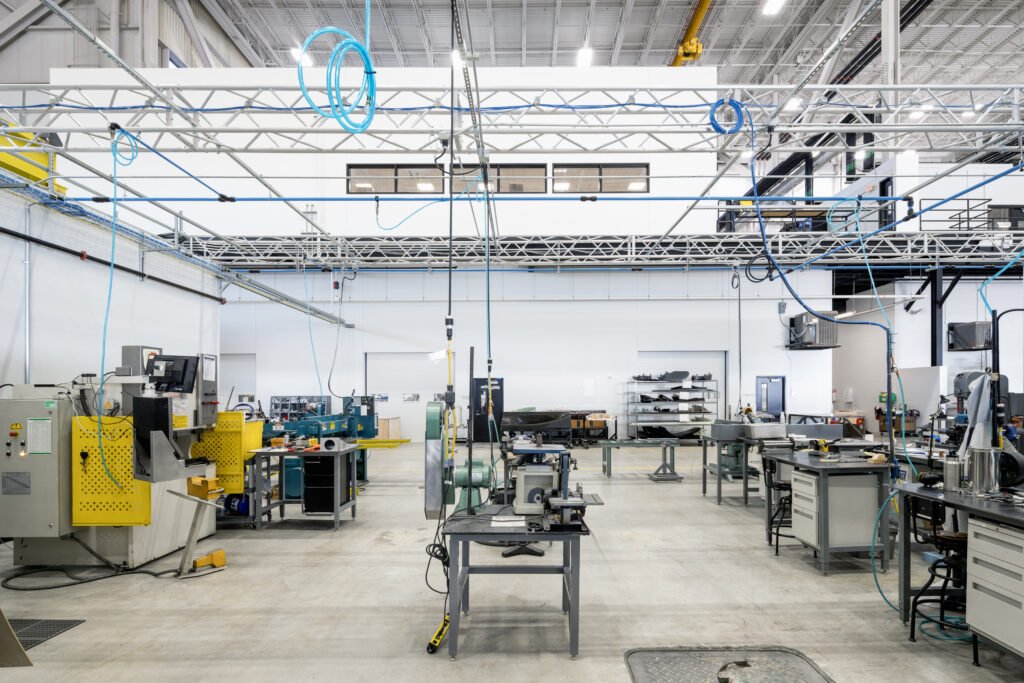
A manufacturing building is a shell wrapped around utilities. Power service, compressed air, process water, wastewater pretreatment, and sometimes chilled water or dust collection set the structure and the site. We start every plant estimate with the equipment list and its utility loads, not with a square foot figure, because two buildings of the same size can differ by a factor of two in cost depending on what runs inside.
Floors are the next topic. Machines may need isolated foundations, heavy-point loads or tight flatness, and the slab design must match. Our manufacturing facility construction approach brings the equipment supplier's foundation drawings into the structural design early, so slabs are poured once, not cut after installation. Office, locker, quality lab and clean-room areas complete the program, and we price each as a separate component so you can phase them.
The most important trade on a plant job is concrete, because everything else depends on it. We schedule and inspect foundations, slab-on-grade and site concrete closely, which lets us control the sequence, the cure time and the quality of flatness. Floor slabs for heavy equipment use joint layouts that follow the machine locations, not the building grid, and we coordinate them with the process engineer.
We also handle earthwork and the building pad. The Hidalgo soil series, named for this county, is described as well drained and moderately alkaline, with weakly cemented calcium carbonate concretions and lime layers that begin at depths of about 12 to 28 inches. For a plant that means the geotechnical report matters, and we use it to decide on pad preparation and the base under heavy floors. The commercial concrete floors crews we coordinate take responsibility for the surface the equipment sits on.
McAllen's industrial supply is deep and moving west. The Nearshoring Campus Industrial Park between Idela and Ware Road was reported in 2023 as a $120 million investment through multiple phases on a site of about 473,400 square meters with lots up to 121,000 square meters. A foreign-trade zone designation covers Hidalgo and Willacy counties, which helps manufacturers that import components and export finished goods. In Mission, a planned $50 million, 98,000 square foot automated metal-recycling plant was reported, with roughly 240 permanent and temporary jobs expected.
Manufacturers coming here often share a supply chain with logistics and distribution operators, who ship components in and finished goods out. We see the two as neighbors, and a plant that is near a warehouse park with good truck access saves freight cost. See the Ware Road industrial area for the land and utility picture.
Site selectors rank land by power, water, wastewater, road access and labor. After a site is chosen, the builder finds the rest: the storm outfall, the fire flow, the size of the transformer pad and the permit timeline. In this county, drainage deserves attention. Hurricane Hanna produced more than 12 inches of rain at gages near McAllen in July 2020, and the county drainage district has said its system was originally agricultural and not designed for such events.
We price detention and pad elevation early and review the floodplain mapping on the parcel. For plants that need long-lead electrical gear, we recommend ordering transformers and switchgear as soon as the load is set. The same logic applies to structural steel and overhead cranes, which our crane building work coordinates with the structural frame.
For a manufacturer, the schedule ends when product leaves the line, not when the building passes inspection. We work backward from start of production through equipment set, utility commissioning, trial runs, safety audits and the certificate of occupancy. Equipment installers need clean, dry, powered space, so the building envelope, power and floor must be ready at the equipment date. We sequence the building so those three milestones come first, and interior finishes follow.
If the plant is the first of several phases, we plan the first building so later phases do not disturb it. Utility stubs, truck courts and the parking field are laid out for the full campus, even if only part is built now. Developers who build for lease should read about our work with commercial real estate developers, since a build-to-suit plant often starts as a developer-owned shell.
Give us the process layout, the utility loads and the date production must start. We will return a phased plan, a price range and a list of the items most likely to move the schedule.
The equipment list with utility loads and weights, the floor plan, the site and the target start of production. With those we can give a range quickly. Without them, any number is a guess, because the process drives the structure and the utilities.
Not directly. The zone helps with duties on imported components and finished goods, so it affects site selection and operating cost. We coordinate with the zone operator on warehouse and receiving areas when the owner uses the zone.
Local soils in the area are described as well drained but with lime layers and cemented concretions at modest depth. That can help bearing capacity but complicates deep excavation. The geotechnical report decides pad preparation, and we price the floor base from it.
Yes, if the site is laid out for it. We separate construction traffic from production traffic, extend utilities in stages and avoid shutting down service to the live plant. Planned shutdowns happen on weekends or planned maintenance days.
Electrical gear and process equipment lead times, followed by late design changes. We list the long-lead items at the first estimate and track delivery weekly. Changes to the process after foundation work often cost more than they appear.