
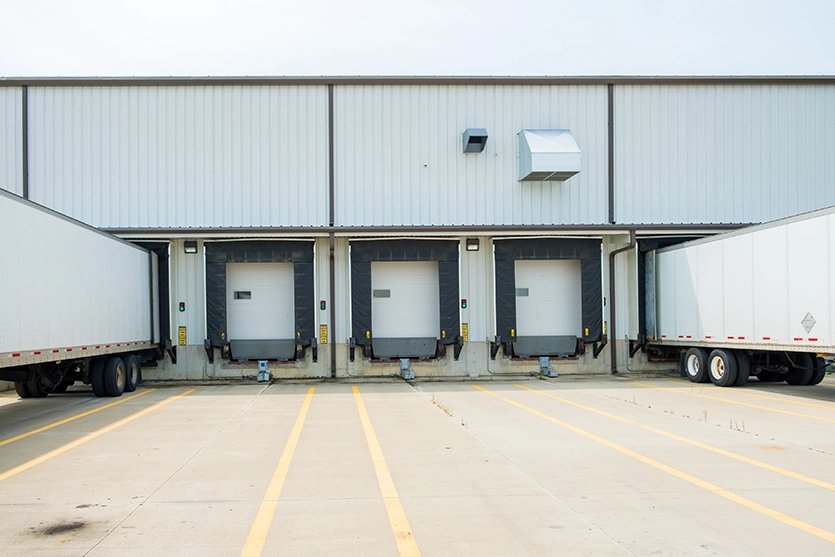
Every minute a trailer sits waiting for a door costs a carrier money, and a terminal exists to cut that wait to almost nothing. A cross-dock does it by skipping storage: freight comes off an inbound trailer at one side of the building, crosses the floor and goes onto an outbound trailer on the other side, often within hours. The building is a narrow box with doors on both long walls and a lot of pavement around it.
That shape explains the economics. A cross-dock tends to be a long, narrow building with a door every dozen feet or so along both sides. Land cost is driven by yard depth and trailer parking, not by the footprint of the roof. In the McAllen area, where freight turns at the bridges and heads north on the interstate, a terminal near the crossings can save carriers a lot of deadhead time.
We build terminals for carriers, freight forwarders and developers who lease to them. The program is not complicated, but the details matter: concrete aprons, truck circulation, lighting, drainage and security. For storage-heavy programs a distribution center is the better fit.
An $83 million expansion of the Anzalduas international crossing broke ground in October 2022 to add commercial inspection booths, docks, roadway and parking so the port could serve commercial trucks, funded by a $25 million federal INFRA grant, a $22 million state grant and a $63 million North American Development Bank loan to the City of McAllen. A trade-press report in December 2024 said the expansion adds one northbound and one southbound commercial truck lane and is estimated to handle 1,200 to 2,000 trucks a day when finished.
More trucks means more places for them to park, switch and transfer. Texas Comptroller data shows the Port of Hidalgo, which includes the Anzalduas and McAllen-Hidalgo international bridges, recorded nearly 19.4 million total border crossings in 2024. The City of McAllen's FY 24-25 budget book states the goal that the Anzalduas Bridge Land Port of Entry will be expanded to facilitate commercial traffic, so the city itself treats freight as a planning priority. Our page on the Anzalduas bridge area covers the surrounding parcels, and a long, shallow lot that fits a terminal poorly may suit a warehouse instead. Terminal sites inside the City of Hidalgo serve the other crossing.
The yard is the product. A tractor-trailer needs a deep apron in front of each door to back in, often well over 100 feet counting the turning path, and the truck court needs a turning path wide enough for a fully loaded rig. If the lot is too shallow, door count falls and the economics break. We test turning with software and then check on site with painted layouts before paving.
Pavement is the largest hard cost. Constant turning and braking beat up asphalt, so most terminals use reinforced concrete at the doors and aprons. Our truck courts and dock aprons page explains slab thickness, jointing and subgrade treatment. For the remainder of the yard, trailer parking and driveways, parking lot construction methods apply, with heavier sections than a normal retail lot.
The scope covers the cross-dock building itself, usually a tilt-up or steel frame with minimal insulation, dock levelers and seals, a small office and driver lounge, restrooms, a maintenance bay in some cases and a guard shack. Fuel islands and truck wash bays are sometimes added, with their own environmental rules.
Lighting and security deserve attention because terminals run through the night. LED fixtures on tall poles, cameras at gates and fenced perimeters all belong in the budget. Owners should also plan for stormwater: a large paved yard sheds a lot of water in a heavy rain, and detention basins take land. The mass grading crews we coordinate shape the site so water leaves the dock aprons and reaches the detention area without ponding.
On a terminal, paving and site work often exceed the building cost. Door count and yard depth multiply the concrete. The next driver is lighting and security, then dock equipment, then the building shell. Cheap building shells paired with strong pavement are the usual formula.
Bridge counts matter for risk. FreightWaves reported that the city processed 42,749 empty southbound trucks in 2023, which is a reminder that southbound loads are not always full. A terminal operator should model inbound and outbound flows separately, because empty equipment also needs yard space and a door when it is repositioned. We help developers compare site options using a simple per-door cost and an estimate of trailer storage capacity.
Building a terminal means building next to heavy equipment, and often next to live traffic. We separate construction access from truck routes with fencing and flaggers, post speed limits inside the site and brief every trade on where trailers will travel. Delivery drivers for concrete, steel and rock follow the same rules as the owner's carriers.
Fueling, washing and trailer maintenance bring spill rules and stormwater controls. We install containment, oil-water separation and covered work areas as the permits require, and we document inspections so the owner has a record at closeout. A clean site record speeds the certificate of occupancy and helps when an insurer or lender asks questions later.
Terminals are often built beside operating yards or expanded in place. We phase paving so that trucks can keep moving, with temporary routes and night pours where needed. Concrete aprons need curing time before trucks can use them, so we plan that time in the schedule and put barricades in place.
Shared use with other freight operators, such as those in the logistics and distribution sector, adds access agreements and utility coordination. We handle these before ground is broken.
Share your lane volumes, door count target and parcel. We will test the yard geometry, price the paving and dock wall, and send back a sequence and range that carriers and lenders can read in one sitting.
It depends on daily trailer counts and dwell time. We start from peak-hour inbound and outbound trailers, add the time each one occupies a door, and then test the result against the lot shape. The door count that comes out is usually bigger than owners guess, and we price the extra doors as a separate line so you can decide.
Concrete at the dock and turning areas, asphalt for lighter parking, is the common mix. Concrete costs more upfront but holds up under braking and standing loads.
Zoning and traffic review are the usual concerns. Cities ask about truck routes, noise and lighting. We prepare a truck-movement exhibit and talk with city staff before submission.
A lot. Detention can take a meaningful share of the site, depending on the local rules and the district. We design the grading and basins together so land is not wasted.
Sometimes. If we design the slab, column grid and roof for extra load and add a removable wall, the building can be changed. It adds cost at the start.