
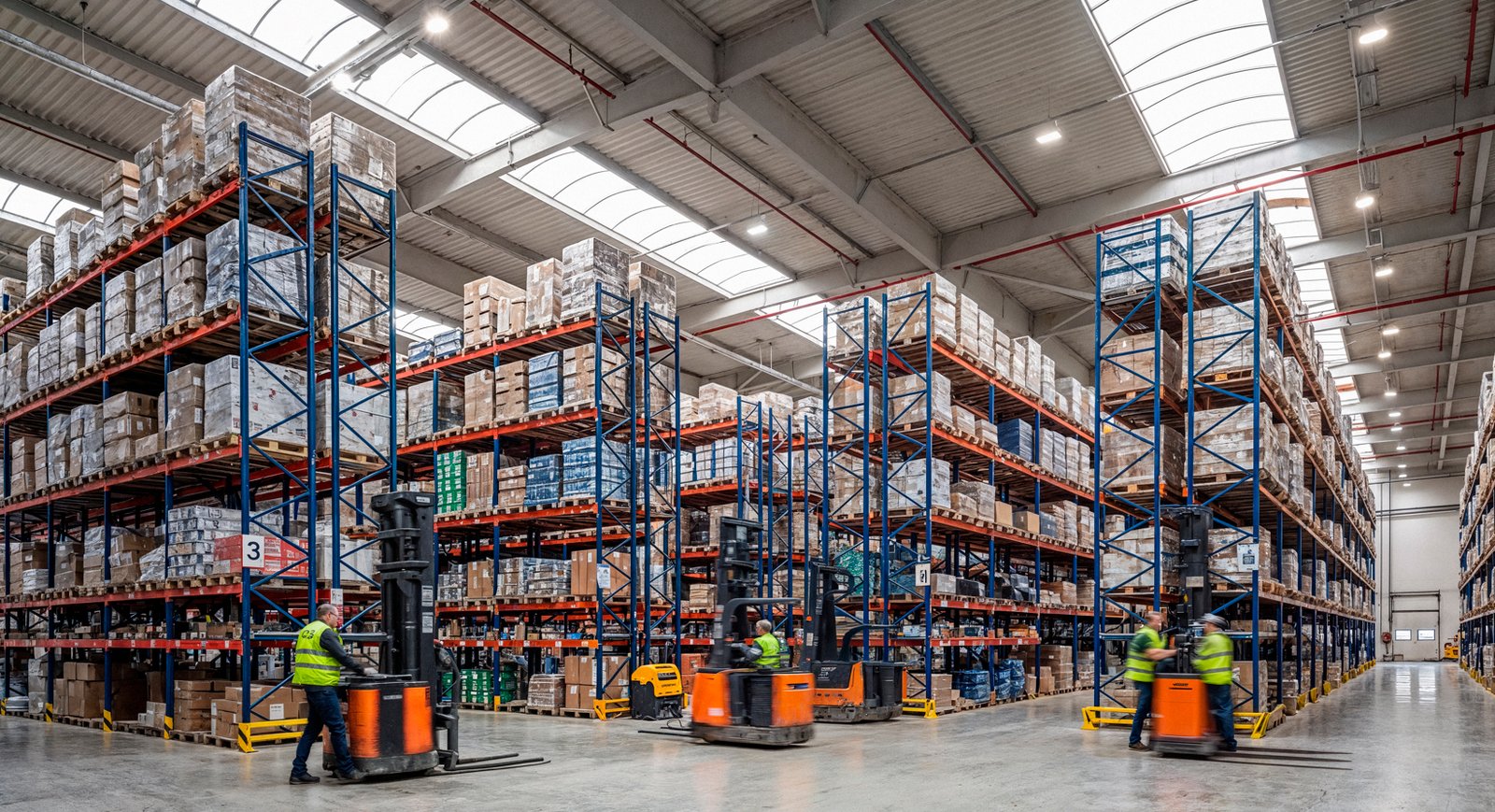
Returns, same-day pick-up and an order that has to leave by a cutoff time make a fulfillment center a different building from a bulk warehouse. The floor is busier, the mezzanines are taller, the power is heavier and the labor is bigger. A fulfillment operator in the Valley also has a regional wrinkle: some goods arrive through a foreign-trade zone, some leave by air from a designated site at the airport, and many head north on Interstate 2 and US 83, the city's major east-west artery.
We build fulfillment and logistics centers for operators who care about throughput per square foot and about how quickly the building can be ready for peak season. The program usually includes receiving docks, pick modules on one or more mezzanines, packing and shipping areas, returns processing, an office with a break room and a trailer yard. Many include conveyors and sortation lines that need dedicated floor and power.
The sections below explain how codes and free-trade rules apply, how the market works, how we plan around automation and what moves the schedule. Heavier bulk uses are described under distribution center construction.
The Valley has an unusual layer of trade infrastructure. Foreign-Trade Zone 012, administered by a grantee in McAllen, serves Hidalgo and Willacy counties, and a zone designation site is located at McAllen Miller International Airport to support air cargo. Operators who use a zone need physical features that satisfy customs: controlled access, inventory systems and sometimes a secured cage or room. We build the physical part and coordinate with the zone operator on what is required.
On the building side, McAllen has adopted the 2024 International Codes and the 2023 National Electrical Code effective January 1, 2026. Mezzanines, high-piled storage and automated systems all draw attention at plan review (the same storage questions come up in warehouse construction), and sprinkler design for racked storage with automated equipment needs early review. We submit a complete package through the city's online portal and respond to comments within the week.
The Anzalduas bridge is meant to serve commercial traffic, with the city budget stating the goal that the land port of entry be expanded to facilitate commercial trucks. For a fulfillment operator that matters because freight patterns follow bridge capacity, and a site within a short drive of the crossing can serve both directions of trade.
Interstate 2 travels through McAllen from Taylor Road to Sugar Road, so a building along it can reach much of the Valley by road. The airport adds an air option for time-sensitive goods. We help operators think about which of these matters most for their business, then choose a site that matches. Our airport area experience is useful for those who want proximity to air cargo, while Ware Road serves those who want industrial park amenities.
A fulfillment center often has more steel than a warehouse of the same area. Pick modules sit on mezzanines that carry people, product and conveyors, and the columns for those platforms continue down to foundations. We design the mezzanine grid with the tilt-wall or metal building grid so that columns line up and floor loads are carried properly. Conveyors and sortation add loads and vibration, which affect slab design.
We also coordinate with automation vendors early. Their equipment layout controls column spacing, aisle widths and electrical routing. A late change in the vendor's layout can cost weeks, so we ask for a preliminary drawing at the start and build the structure to suit. Where a vendor is not yet chosen, we design with flexibility and note which items are fixed.
Fulfillment centers employ many workers, and the site must handle them. Parking counts are often higher than for a bulk warehouse, shift changes create peaks in traffic and the building needs restrooms, break areas and lockers in proportion. We check municipal parking ratios and plan the employee entrance separately from the truck entrance, because mixing them causes delays and safety issues.
Peak season is the schedule driver. Many operators need the building ready before a seasonal surge, which sets a hard date. We build the schedule backward from that date, include float for permits and weather, and keep a list of what can be finished after occupancy. Owners in retail chains often have fixed launch dates and plan around them.
Beyond the base building, three items drive cost. The first is mezzanine area, as steel and fire protection are expensive per square foot. The second is electrical service for lighting, conveyors, charging and HVAC. The third is the truck and parcel yard, which can take as much land and paving as the building. Automation equipment is usually bought by the operator, but the building has to be ready for it.
We separate the budget into base building, fulfillment fit-out and site. That allows an operator to defer part of the program, or a developer to build the base building and let the tenant finish the rest. Design build can shorten the schedule when the program is clear, and we discuss it early.
The schedule has four chapters: entitlement and design, site and structure, systems and automation, and commissioning. The longest items are typically electrical gear, fire protection materials and automation equipment. We submit early release packages, order long-lead items first and track delivery weekly.
Commissioning is more than turning on lights. Conveyors, scanners, sprinklers, fire alarms and trailer systems must work together. We plan time for integrated testing and for training the operator's staff. Opening a building without that step tends to cost more than it saves.
Tell us your order profile, automation plans and opening date. We will return a sequence and price range with the items that move it.
A fulfillment center handles individual orders, often with more labor, mezzanines and conveyors. A distribution center moves pallets in bulk. The design therefore differs in structure, power, parking and fire protection. We help operators decide which format fits.
Only if your business benefits from deferring or reducing duties on imported goods. The decision belongs to your trade advisers. If you do use a zone, we build the physical features it needs.
Cost depends on span, load and fire protection. Mezzanines are usually priced per square foot of platform, and they add sprinkler, lighting and egress. We include them in the early budget so you can compare options.
Often yes, if the site and permits are in place early and long-lead items are ordered immediately. We show a critical-path schedule so you can see the risks.
Plan for your peak shift, not the average. Check municipal ratios, then adjust for your labor model. We lay out parking with the truck yard to keep both flows separate.